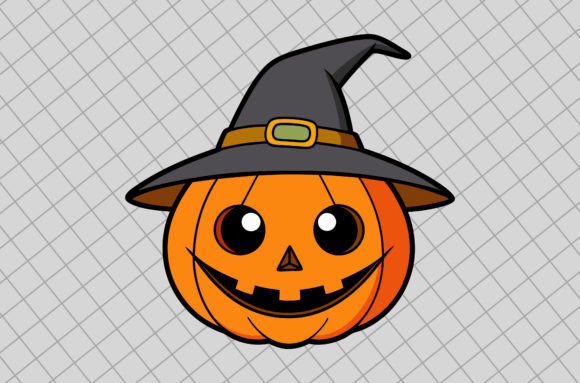
Halloween Pumpkin Vector Illustration
First Impressions: A Clean, Confident Silhouette That Speaks Halloween—Without the Clutter
Opening Halloween Pumpkin Vector Illustration feels like unboxing a well-edited sketchbook page: one bold, centered pumpkin silhouette, no frills, no filler. It’s not cartoonish or cutesy—it leans into retro charm with subtle scalloping and a gentle asymmetry in the stem that gives it quiet character. As an embroidery designer who’s stitched hundreds of holiday motifs, I immediately sensed its strength: it’s built for clarity, not complexity. That matters—because embroidery isn’t about pixel-perfect vectors; it’s about how shape translates to thread on fabric.
A Real Project Test: Embroidering This on a Linen-Cotton Kitchen Towel
Last week, I used Halloween Pumpkin Vector Illustration for a small-batch run of embroidered kitchen towels for a local boutique. We chose natural linen-cotton blend—textured, slightly uneven, and unforgiving with dense stitching. I resized the design to 3.2" wide, digitized it as a fill-stitch motif with light satin-stitch edging, and ran a test on scrap. The result? Crisp edges, breathable stitch density, and zero puckering—even without heavy cutaway stabilizer. Customers loved how the pumpkin “sat” on the towel instead of overwhelming it. That’s the quiet power of this design: it enhances handmade product appeal without shouting.
Where It Shines (and Where It Needs Thought)
Halloween Pumpkin Vector Illustration excels in projects where simplicity reads as intention—not limitation:
- Custom apparel: Works beautifully on sweatshirt cuffs, back yokes, or chest pockets—especially when paired with minimal text or monogramming.
- Embroidered patch: Its clean outline and moderate detail level translate cleanly to woven or chenille backing.
- Baby embroidery: Gentle scale and lack of tiny interior details make it ideal for onesies and burp cloths—no risk of stiff, scratchy fills near delicate skin.
- Holiday embroidery for small shop products: Fits seamlessly on tea towels, pillow covers, and aprons—items buyers associate with thoughtful, tactile gifting.
- Digital embroidery file use for Etsy sellers: Because it’s a vector-based graphic, it scales cleanly for printable mockups, social previews, and listing banners—no jagged edges or blurry exports.
Use With Care: Texture, Scale, and Fabric Realities
This isn’t a “drop-in-and-stitch” design for every surface—and that’s okay. Here’s where attention pays off:
- Stretchy fabric: On knits or lightweight t-shirts, the outer edge needs a light tear-away + iron-on hybrid stabilizer—otherwise, the satin-stitch perimeter can ripple.
- Dark fabric: The silhouette works in black thread, but test contrast first. On navy or charcoal, a single layer of white underlay improves definition without adding bulk.
- Curved surfaces: For caps or structured tote bag handles, reduce width slightly (to ~2.7") and simplify any internal contouring—embroidery hoops don’t bend, and neither should your expectations.
- Tiny lettering or layered elements: Note that this is a standalone pumpkin silhouette—not part of a quote bundle, despite the product description mentioning “Retro Halloween Quote SVG.” Don’t assume combo layouts are included. If you need text integration, plan separate digitizing or pairing.
What This Design Says About Your Brand—Before a Single Stitch
Using Halloween Pumpkin Vector Illustration signals care in curation. It doesn’t scream “Halloween!” with bats and cobwebs—it invites recognition through confident restraint. That builds customer trust, especially for handmade product buyers who scroll past busy, overdesigned listings daily. On an Etsy page, it helps your embroidered patch or custom apparel stand out in a sea of clip-art clutter. In a boutique setting, it supports brand consistency—whether you’re selling seasonal nursery decor or elevated holiday gifts for adults.
Practical Embroidery Designer Notes You’ll Actually Use
Before cutting fabric or uploading to your machine:
- Test on scrap fabric first—especially if using textured weaves or blends. Linen, terry cloth, and chambray behave differently than smooth cotton poplin.
- Review stitch density in your embroidery software. If fill areas look overly dense at your intended size, reduce density by 5–8%—it breathes better and wears longer.
- Confirm hoop size compatibility. At 4", this design fits standard 4x4 hoops comfortably—but always check your own machine’s max stitch area.
- Inspect small details in the stem and vine curves. Some vector imports retain unnecessary anchor points—clean those before digitizing to avoid erratic jump stitches.
- Try black-and-white mockups. Does the shape hold up in monochrome? If yes, it’ll translate reliably across thread colors and fabric tones.
- Check licensing. Since this is listed as a digital download in SVG, EPS, and JPEG formats—and categorized under Graphics, not pre-digitized machine embroidery design—confirm whether commercial use of finished embroidered items is permitted. When in doubt, contact the seller.
Final Thought: Not Just a Graphic—A Thoughtful Starting Point
Halloween Pumpkin Vector Illustration isn’t flashy—but then, the best design assets rarely are. It’s the kind of craft business staple that earns repeat use: on a baby onesie in October, reworked as a heat-transfer vinyl cut for a coffee sleeve in November, simplified into a line-drawing for a greeting card in December. It belongs in your library not because it’s trendy, but because it’s reliable. And for designers, sellers, and makers building real livelihoods—one embroidered tote bag, one Etsy order, one holiday gift at a time—that reliability is everything.